
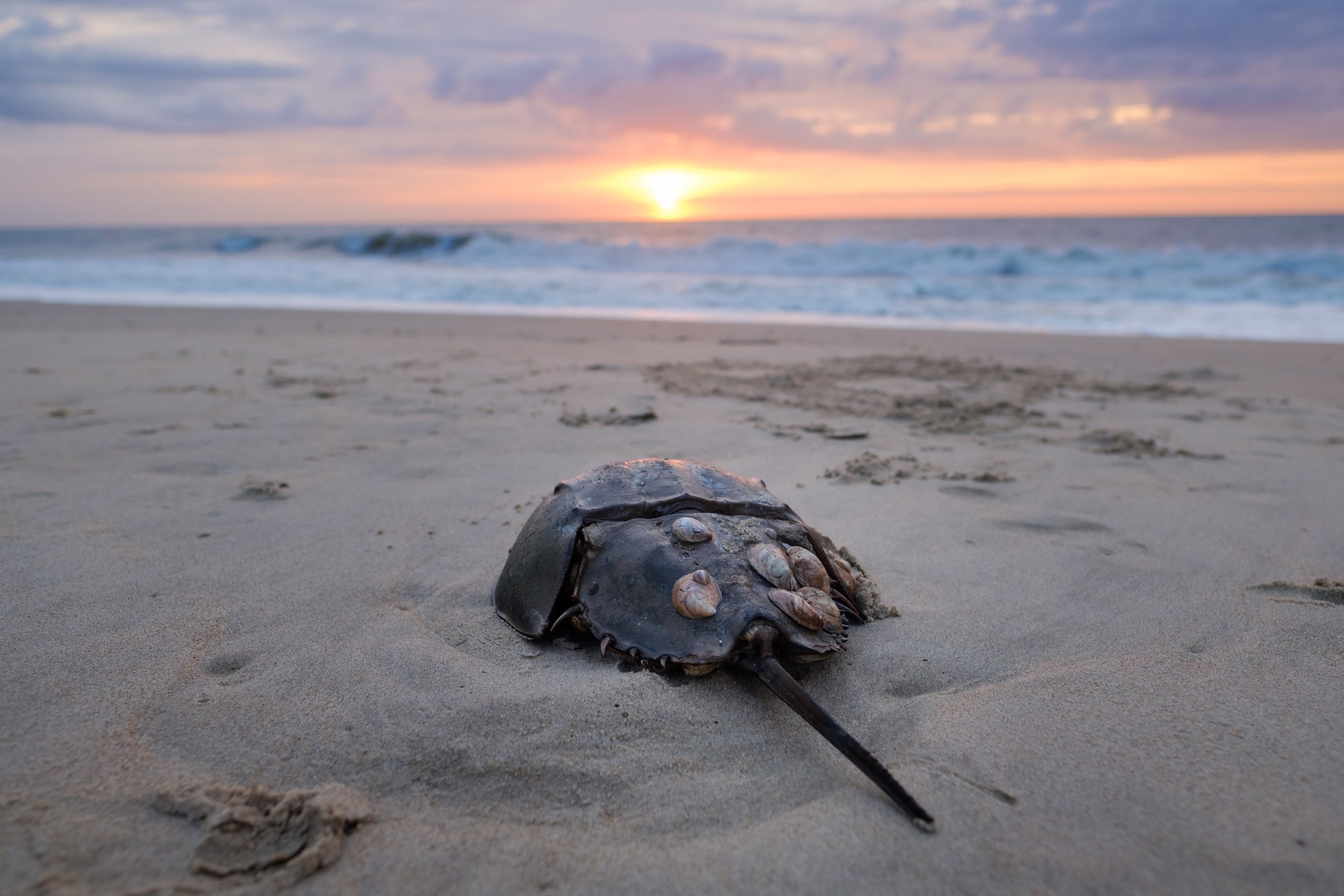
Horseshoe crabs are living fossils, older than trees—they predate dinosaurs by 200 million years, survived the asteroid that ended the Cretaceous period, and have remained largely unchanged for eons. But survival through deep time doesn’t guarantee survival of human industry.
This ancient species which has survived five mass extinctions over 450 million years, now faces a modern threat: the pharmaceutical industry’s dependence on its blood for drug safety testing, a practice which has depleted horseshoe crab populations.
Bleeding blue
For over 50 years, pharmaceutical companies have harvested horseshoe crabs to extract Limulus Amebocyte Lysate (LAL), a substance derived from the crabs’ copper-based, blue blood which is used to detect bacterial contamination in injectable drugs, vaccines, and medical devices.
Each year, biomedical companies harvest about 1.1 million horseshoe crabs from Atlantic coast waters. The crabs are bled up to 30% of their blood before being returned to the ocean. While industry estimates claim crab mortality rates of only 10-15%, independent research suggests the actual figure is closer to 30%. Unfortunately, the practice has expanded dramatically. Between 2018 and 2024, horseshoe crab harvests for biomedical use increased by approximately 115% to meet the demand for newer vaccines, monoclonal antibodies, biologics and injectables for diabetes and weight loss.
Pharmaceutical companies worldwide use horseshoe crab blood for testing, including endangered Asian horseshoe crab species, creating a global supply chain issue.
Supply chain risk
Horseshoe crabs are a keystone species for coastal ecosystems. Every spring, they emerge from the Atlantic to spawn on beaches, laying billions of protein-rich eggs in the sand. This ancient ritual fuels one of nature’s most remarkable synchronized events: the arrival of thousands of migrating shorebirds, including the red knot, completing a 9,000-mile migration from Tierra del Fuego in Chile to the Arctic. These birds have evolved by timing their journey with this singular food source, arriving at Delaware Bay exhausted and emaciated, needing to double their body weight in just two weeks to fuel their final push to Arctic breeding grounds.
When horseshoe crab populations decline, red knots starve. Since the 1980s, red knot populations have declined by 75%, tracking almost perfectly with horseshoe crab declines. The biomedical industry’s harvest intersects with this ecological choreography at the worst possible moment: bleeding occurs during spawning season, and the stress of capture and blood extraction reduces both survival and reproductive success of returned crabs.
This is what’s at stake when we talk about “supply chain risk”—not just business continuity, but irreplaceable ecological relationships that have sustained themselves for millennia.
Removing barriers
Fortunately, pharma now has a synthetic and approved alternative allowing it to step away from horseshoe blood extraction—the question is whether it will choose to do so.
Synthetic alternatives like recombinant Factor C (rFC) have been available since 2003. These lab-created alternatives replicate the key enzyme from horseshoe crab blood without requiring any animal harvesting, offering more consistent results, fewer false positives, and lower costs.
The regulatory barrier that previously limited adoption of synthetic alternatives has been eliminated. In November 2024, the U.S. Pharmacopeia adopted Chapter 86, putting synthetic alternatives on equal regulatory footing with horseshoe crab blood. As of May 1, 2025, these guidelines are in full effect.  European regulators approved synthetic alternatives in July 2020. Given that pharmaceutical companies operate in global markets, with products requiring approvals across multiple jurisdictions, this international regulatory alignment matters for a successful industry transition.
Despite regulatory approval and proven alternatives, about 80% of pharmaceutical companies have yet to transition away from horseshoe crab blood.
Industry leadership
The transition to synthetic alternatives is not theoretical—industry leaders have already proven it works. Eli Lilly stands out as the gold standard. Since 2016, the company has transitioned approximately 80-85% of its endotoxin testing to synthetic alternatives. In 2018, Eli Lilly received FDA approval for the first medicine tested using rFC, and has since achieved approval for at least eight additional products globally.
The business case is clear: companies that have made the transition report cost-effectiveness, supply chain security, and improved quality control. However, the majority of the industry has not yet disclosed implementation plans, despite elimination of regulatory barriers and the success of early adopters.
What companies can do
For pharmaceutical companies still relying predominantly on horseshoe crab blood, the path forward is clear:
Start with low-hanging fruit: Water and raw material testing can transition to synthetics relatively quickly. Industry sources indicate this represents approximately 80% of current horseshoe crab blood usage and requires minimal regulatory approval.
Publicly disclose current practices: Report current LAL vs. synthetic usage percentages, supply chain risk assessments, transition timelines, and integration with existing animal welfare commitments.
Establish concrete transition timelines: Following Eli Lilly’s model, set specific percentage targets and dates. Make synthetic alternatives the default for new products.
Engage with the sustainability scorecard: Participate in the pharmascore.org survey and engage transparently with stakeholders.
Material risk
Supply Chain Vulnerability: Depending on a wild-harvested and declining resource creates inherent supply chain instability. Geographic concentration of horseshoe crabs along the Atlantic coast compounds this risk.
Regulatory Risk: State restrictions are expanding to protect horseshoe crabs. New York Governor Kathy Hochul signed the Horseshoe Crab Protection Act in December 2025, which will phase out biomedical and commercial harvesting over three years, with full prohibition taking effect in 2029. New Jersey has maintained a moratorium since 2008, and conservation groups are pushing to eliminate biomedical exemptions.
Reputational Risk: As biodiversity loss becomes a more prominent concern by investors, companies’ impact on the environment, including their role in species depletion, will come under increasing investor scrutiny.
Cost and Quality Issues: LAL suffers from lot-to-lot variability and can produce false positives, while synthetic alternatives offer more consistent, reliable results at lower cost.
Sustainability scorecard
To create transparency and accountability, a coalition of conservation organizations—Revive & Restore, the Horseshoe Crab Recovery Coalition, and the Center for Biological Diversity—launched the Sustainability Scorecard for Endotoxin Testing in December 2024.
The scorecard surveys the world’s 50 largest pharmaceutical companies on their endotoxin testing practices and any plans to adopt synthetic alternatives. Companies are evaluated across five categories: elimination of endangered Asian horseshoe crab use, public acknowledgement of synthetic benefits, LAL reduction, new product transition, and legacy product conversion.
Results are publicly available at pharmascore.org, allowing consumers, investors, and stakeholders to understand which companies are leading and which are lagging.
The choice before us
Horseshoe crabs have survived 450 million years and five mass extinctions. Their blood has saved countless human lives—yet our continued harvesting of it now threatens their survival. Proven synthetic alternatives are regulatory-approved and economically superior; the pharmaceutical industry need only overcome its inertia. A species that survived asteroid impacts and ice ages shouldn’t face extinction from corporate complacency.