Social Justice Blog Posts
Featured

















When you put money into a retirement plan, you’re doing more than saving for your future. You’re also investing in the companies that shape our economy and our society. Yet many retirement savers don’t realize that their investments may be supporting workplaces with weak or opaque equity practices.
For investors who care about justice, the hidden connection between mutual funds and historically marginalized communities matters. That’s where Social Justice Funds comes in: helping investors see not just the financial performance of funds, but also the racial justice implications behind them.
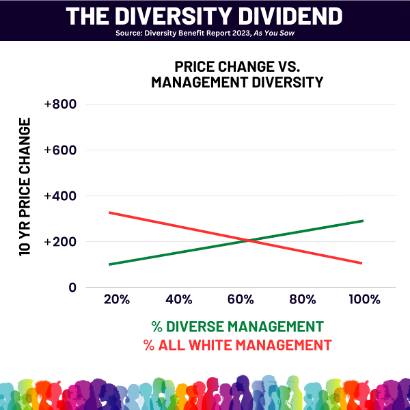
How do the returns of mutual funds correlate with their gender equality, diversity disclosures, racial justice, and LGBTQ+ equity ratings? As we worked on Social Justice Funds, our newest Invest Your Values tool, we wondered if we would find a similar correlation between higher percentages of BIPOC management and increases in financial metrics.
Most workplace retirement plans invest in funds that represent business-as-usual: fossil fuels, private prisons, and corporations that perpetuate systemic bias, reinforce structural racism, widen the gender pay gap, and inflict harm on historically marginalized communities. This is a story we’re hearing more and more, and it’s exactly why we’ve created Social Justice Funds.
We have gained so much collectively from the hard-won battles of organized workers. This week was International Workers' Day, also known as May Day, and As You Sow invites you to join us in celebrating working people and their achievements. Not one of the companies we engage could succeed without the labor of their workers. From cashiers to software engineers, wage workers are the backbone of our economy. Workers have propelled these companies to fantastic financial success.
Why are Elon Musk and Mark Cuban publicly feuding over workforce diversity? The billionaire beef is part of a larger conversation making headlines on corporate programs meant to improve diversity, equity, and inclusion (DEI) in the workplace.
Under Executive Order 12898, federal agencies will make environmental justice core to their mission and practices; requiring each to create agency-wide environmental justice strategies, amongst other important goals.
In order to allow their investors to understand their workplace diversity, 87 of the S&P 100 companies have released or have committed to releasing their EEO-1 form, a standardized, government mandated accounting of diversity of gender race and ethnicity by employment levels.
As You Sow has been engaging Facebook, now Meta, with similar resolutions for the past five years asking our company to take responsibility for the material damage to our brand caused by dangerous and criminal behavior, hate speech, and disinformation on our platform.
Transparency and accountability in Nike’s diversity initiatives isn’t something that’s just good for its marketing. It’s something that supports a well-run company. Reports from McKinsey, Credit Suisse, and Stanford’s Graduate School of Business have all linked diversity and inclusion to corporate outperformance.
As You Sow has begun to analyze the specifics of whether and how companies include greenhouse gas (GHG) emissions reduction targets as separate, explicit metrics in their executive compensation plans.
As we watch the climate crisis consume our planet, the role of colonization in the degradation of our environment must be considered. We are witnessing the impacts of extreme temperature changes, raging wildfires, and natural disasters.
I formally move proposal number 5 asking for American Express to report on how it assesses the company’s diversity, equity, and inclusion efforts.
As You Sow’s Racial Justice Initiative has tracked whether corporations acknowledge systemic racism, and whether they back that statement up with community involvement and advocacy.
This resolution requests that Abbott Labs publish a report disclosing the company's plan to promote racial justice. Investors seek quantitative comparable data to understand if, and how, the company is promoting a commitment to racial justice.
Food deserts are geographic areas where at least one third of the urban population lives more than 1 mile away from a supermarket (USDA, 2009). Today, 12.8% of the population (39 million people) live in food deserts.
From Flint’s lead-filled water to Richmond’s poisoned air – corporations and municipal governments have been allowed to pollute and poison marginalized communities.
This resolution requests that Procter & Gamble publish an annual report assessing its diversity and inclusion efforts.
I’m Andrew Behar, CEO of the non-profit As You Sow. This shareholder resolution, is of the utmost importance as it asks the critical question: How do words become actions?
On Jan. 23, As You Sow and Women of the World Endowment sponsored a webinar on gender-lens investing. We discussed how to build market awareness of gender-lens investing products to help scale investments that support gender equality.
Monster Beverage has an obligation to its consumers, its shareholders, and the employees of its supply chain to be transparent. Transparency is the first step in making progress toward ending modern slavery.